
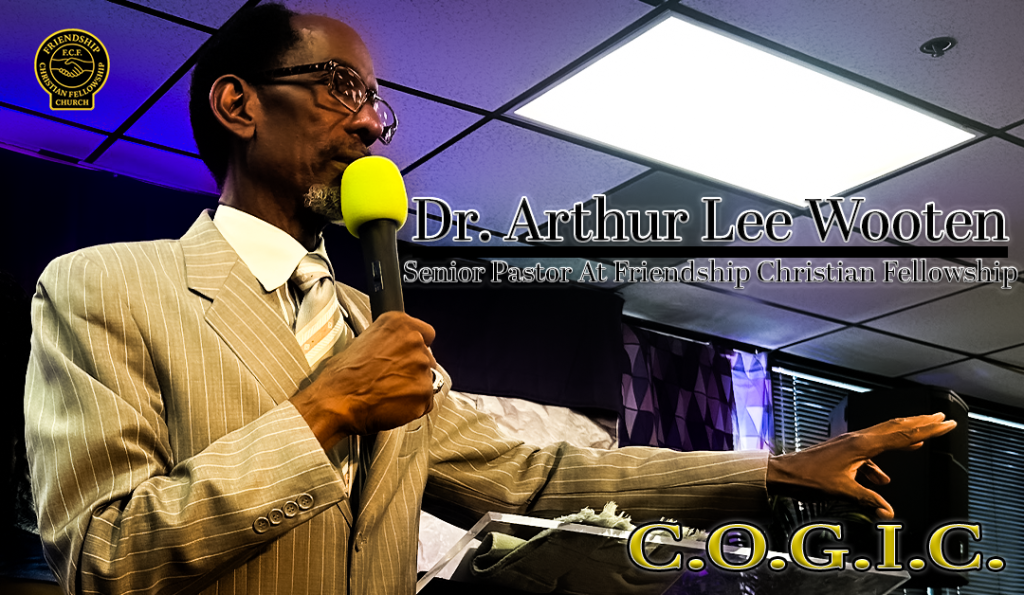
Hebrews 13:17 (ESV)
“Obey your leaders and submit to them, for they are keeping watch over your souls, as those who will have to give an account. Let them do this with joy and not with groaning, for that would be of no advantage to you.”
This reflection is a personal expression of gratitude and faith, shared from my lived experience.
Over the next year, I will be telling stories. Not as commentary or instruction, but as remembrance. Stories about people I have encountered along my journey—individuals whose presence, consistency, and character left a lasting imprint on my life.
Among those individuals, Pastor Dr. Arthur Lee Wooten (Senior Pastor of Friendship Christian Fellowship, Church of God in Christ) holds a distinct place.
Arthur Wooten is my pastor. He often refers to me as “son,” a gesture I receive with appreciation, but his role in my life extends far beyond familiarity or affection. The role of a pastor carries a depth of responsibility that is not always visible from the outside. It involves stewardship, counsel, patience, and the quiet work of guiding others through moments of uncertainty, growth, and reflection.
Within Christian theology, spiritual leaders—particularly teachers and pastors—are described as bearing a heightened level of accountability because of the influence they hold and the responsibility they assume when guiding others. This idea is not presented as a privilege, but as a weight: leadership that is relational, ethical, and answerable.
That concept is not unique to Christianity.
Across cultures, faith traditions, and philosophical systems, spiritual leaders are often regarded as individuals entrusted with the care, formation, and moral guidance of others. Whether called pastors, rabbis, imams, monks, elders, or teachers, the common thread is responsibility. Their words carry influence. Their actions set examples. Their decisions ripple outward into the lives of others.
To lead in a spiritual or moral capacity is not simply to speak—it is to serve, to listen, and to remain accountable to something greater than personal authority. It is a role that requires integrity, restraint, and humility, regardless of tradition or belief system.
This reflection is not meant to elevate one person above others, nor to speak on behalf of any institution. It is simply an acknowledgment of the seriousness inherent in spiritual leadership, and a moment of gratitude for those who accept that responsibility with care.
Some people pass through our lives briefly. Others stand watch quietly, over time, shaping us in ways that only become clear in hindsight. This is one such story.
James 3:1 (ESV)
“Not many of you should become teachers, my brothers, for you know that we who teach will be judged with greater strictness.”

 Joseph Mekael Page
Leave a comment